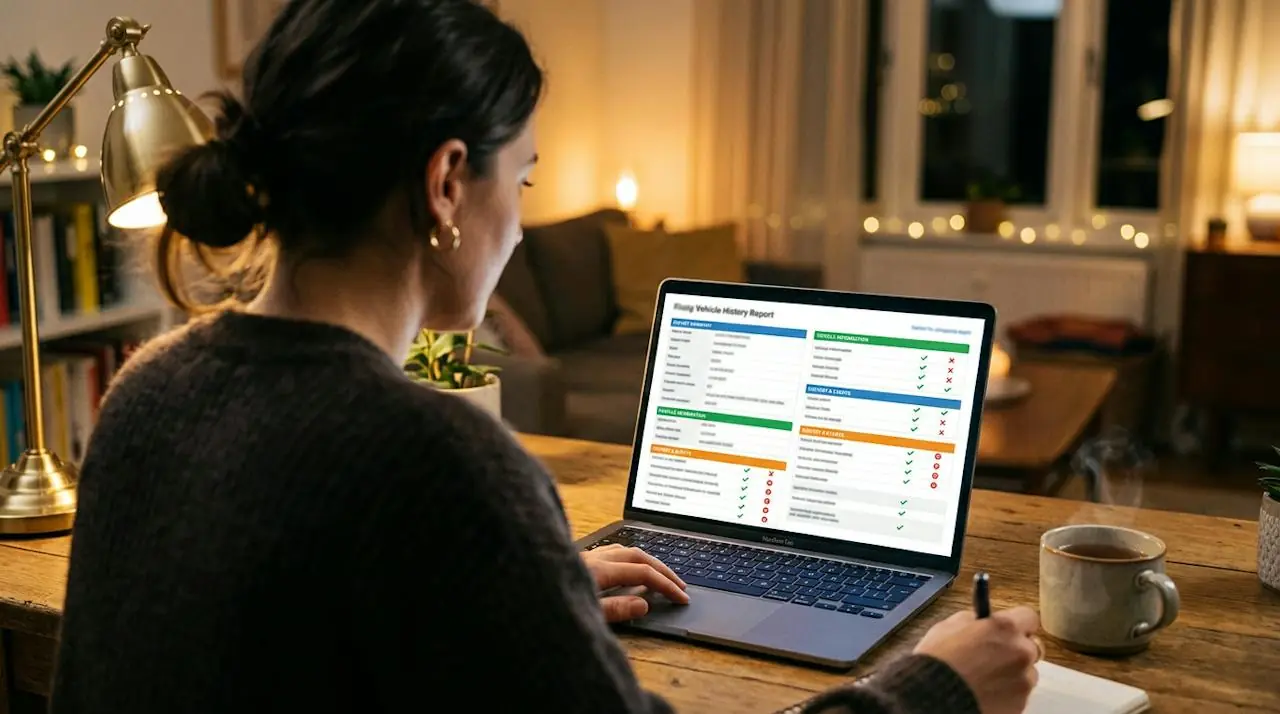
A full HPI check report packs a lot of information into a few screens. It’s tempting to glance at the summary, see green ticks and move on. But the details matter, and knowing how to read them can save you from an expensive mistake.
Here’s how to work through your report, section by section.
Start with the summary
Most reports open with a summary showing which checks are clear and which have a marker. Use it as a map, not the full story. Even if everything is clear, read each section to confirm the details match the car in front of you.
Section 1: Vehicle details
What you’ll see: make, model, colour, engine size, fuel type, year of manufacture, date of first registration and sometimes the last few digits of the VIN.
What to check:
- Do these match the advert?
- Do they match the car itself, including the VIN stamped on the car?
- Do they match the V5C logbook?
Any mismatch, especially the VIN, is a serious warning sign of a cloned or stolen car.
Section 2: Outstanding finance
Clear: no finance agreement is recorded.
Marker: you’ll usually see the type of agreement, the lender, and the date it started. Don’t pay the seller until the finance is settled and you have written confirmation from the lender. See our guide to outstanding car finance.
Section 3: Stolen
Clear: no police record of the car being stolen.
Marker: walk away and consider contacting the police.
Section 4: Write-off
Clear: no insurance write-off recorded.
Marker: look at the category and date. Cat A and B shouldn’t be on the road. Cat S and N can be repaired and driven, but are worth less. Read write-off categories explained before deciding.
Section 5: Mileage
What you’ll see: a list of recorded mileage readings with dates and sources.
What to check: the readings should rise steadily. A later reading lower than an earlier one is a red flag. Compare the latest reading with the odometer and the advert. Our guide to spotting mileage fraud with MOT history shows what to look for.
Section 6: Plate changes
What you’ll see: any previous registration numbers and when they changed.
What to check: plate changes are often innocent. But if a plate change happened shortly before a sale, ask why, and make sure the history across both registrations is clean.
Section 7: Keepers
What you’ll see: the number of previous registered keepers and sometimes the dates of changes.
What to check: lots of keepers in a short period can suggest a problem car being passed on. Ask the seller how long they’ve owned it.
Section 8: MOT and tax
What you’ll see: current MOT and tax status, with expiry dates.
What to check: an MOT due soon means a potential fail and repair costs. Remember you’ll need to tax the car yourself.
Section 9: Valuation (if included)
What you’ll see: estimated values for different types of sale.
What to check: compare the asking price with the right value. For a private sale, use the private value, not the dealer retail value. Our used car valuation guide explains how to adjust for condition.
Quick action guide
| Result | Action |
|---|---|
| All clear and details match | Continue with inspection and test drive |
| Details don’t match | Stop and ask questions. Walk away if unexplained. |
| Finance marker | Settle finance first, get written confirmation |
| Stolen marker | Walk away |
| Cat S or N | Negotiate, inspect, check insurance |
| Mileage issue | Demand proof or walk away |
Save a copy of your CheckHPI report with your purchase paperwork. It’s a record of what you knew when you bought, and it’s useful when you come to sell.
The bottom line
A full HPI check is only as useful as the attention you give it. Match the vehicle details, read every section, and act on anything flagged. Do that, and your report becomes the most powerful tool in your used car buying toolkit.
Frequently asked questions
What should I check first on an HPI report?
Start with the vehicle details. Make sure the make, model, colour and VIN match the car, the advert and the V5C logbook.
What does a finance marker on an HPI report mean?
It means a finance agreement is recorded against the car. The lender may still have a claim, so it must be settled before you buy.
Is a plate change on an HPI report a bad sign?
Not usually. Private plates are common. Just make sure the history across all registrations is clean.
Should I keep my HPI check report?
Yes. Keep it with your purchase paperwork as a record of the car's history when you bought it.