Buying a car privately can save you a lot of money. There’s no dealer margin, and you’re often buying from someone who knows the car’s history inside out. But private sales also come with fewer legal protections, which makes your own checks far more important.
Here’s how to use a vehicle history check, and a few simple habits, to buy privately with confidence.
Your rights when buying privately
When you buy from a dealer, the Consumer Rights Act 2015 says the car must be of satisfactory quality, fit for purpose and as described. Private sellers don’t have to meet the same standard. In a private sale, the car must be:
- As described: the seller mustn’t lie about the car or its history.
- Theirs to sell: the seller must have the legal right to sell it.
- Roadworthy: it’s illegal to sell an unroadworthy car for use on the road, unless it’s clearly sold for parts or repair.
Beyond that, “sold as seen” really does mean you take the car as it is. That’s why checking first is so important.
Why a vehicle history check matters more in a private sale
A reputable dealer will usually check its stock. A private seller might not have, or might not tell you what they found. A full history check reveals:
- Outstanding finance: the seller may not legally own the car outright. See what happens if you buy a car with finance owing.
- Stolen status: the person selling it may not be the owner at all.
- Write-offs: a repaired Cat S car can look perfect but be worth much less.
- Mileage problems: clocking is more common in private sales.
- Plate changes and keepers: useful for spotting a car with a murky past.
Before you view
- Run a free check to confirm the make, model and colour match the advert.
- Look at the MOT history for advisories and the mileage trend.
- Unlock a full check so you don’t waste a trip on a car with hidden problems.
- Ask questions by phone: how long they’ve owned it, why they’re selling and whether there’s any finance.
At the viewing
Check the seller and the address
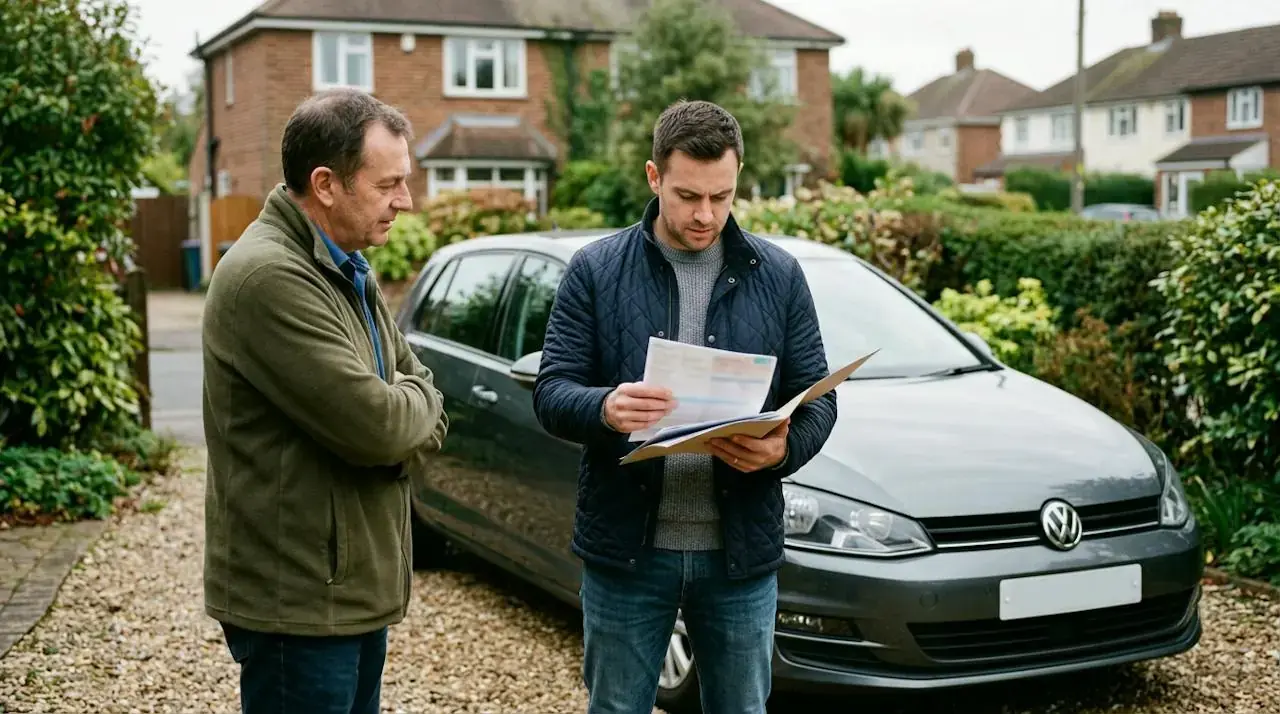
View the car at the seller’s home address, ideally the one printed on the V5C logbook. Be cautious if they want to meet in a car park or lay-by.
Check the V5C logbook
- Make sure it’s genuine. Hold it up to the light and look for the DVL watermark.
- Check the VIN and engine number on the V5C match the car and your history check.
- Remember the registered keeper isn’t necessarily the legal owner, especially if there’s finance.
Check the car itself
Look over the bodywork, tyres and interior, check for warning lights and take it for a proper test drive. Our 10-step used car checklist covers what to look for.
Paying safely
- Re-run your check on the day if more than a few days have passed.
- Avoid large cash payments. A bank transfer leaves a record. Confirm the money has arrived before driving away.
- Get a receipt with both names, addresses, the date, price, registration and VIN.
- Complete the V5C change of keeper online or by post, and tax the car before driving it.
Private sale red flags
| Red flag | Why it’s a worry |
|---|---|
| Seller won’t give the registration | They may not want you to check it |
| No V5C, or “it’s in the post” | Could indicate a stolen or cloned car |
| Wants to meet away from home | Harder to trace if something goes wrong |
| Price far below market value | There’s usually a reason |
| Pressure to decide quickly | A classic scam tactic |
| Only accepts cash | No payment trail |
CheckHPI’s Premium check (£14.99) adds Experian’s mileage check from multiple sources to the essentials, which already include plate change and keeper history, which is ideal for private sales where clocking and hidden histories are more common.
The bottom line
Private sales can be the best-value way to buy a used car, as long as you do your homework. Run a full vehicle history check, view at the seller’s address, check the V5C carefully and pay in a traceable way. Get those right and you can enjoy the savings without the risk.
Frequently asked questions
Do I have any rights when buying a car privately?
Yes, but fewer than with a dealer. The car must be as described, the seller must have the right to sell it, and it must be roadworthy unless sold for parts or repair.
Should I do an HPI check on a private sale?
Absolutely. Private sellers may not have checked the car, and you have less legal protection, so a full history check is even more important.
Is the registered keeper the owner of the car?
Not necessarily. The V5C shows the registered keeper, not the legal owner. If there's outstanding finance, the lender may own the car.
What's the safest way to pay a private seller?
A bank transfer is safest, as it leaves a record. Confirm the payment has arrived, get a written receipt and complete the V5C change of keeper.